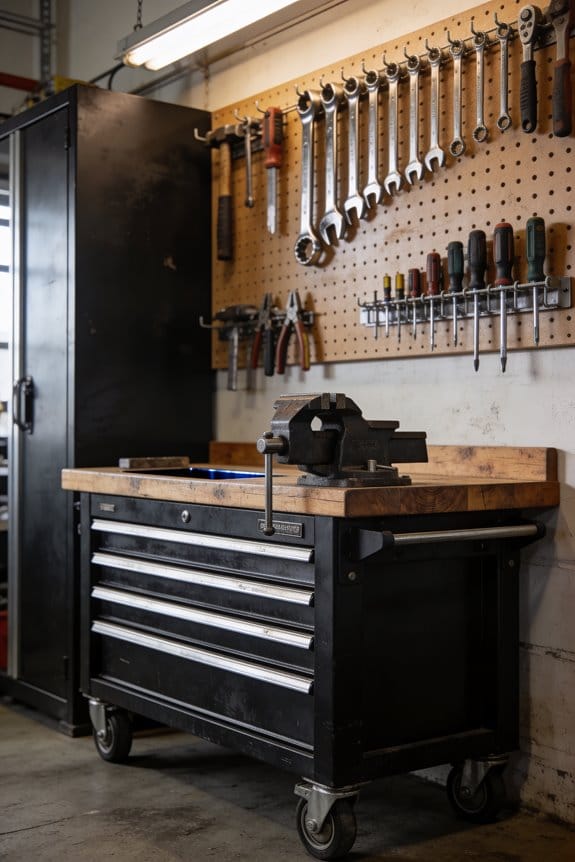
The number of drawers you need depends on your total tool count, the types of tools you own, and how much your collection will grow. I’d recommend counting all your tools and sorting them by category—hand tools, power tools, sockets, and specialty items—to reveal your true storage needs. Most home mechanics do well with 10-drawer chests, while extensive collections require 18 drawers. Plan for 20–30% extra capacity beyond what you currently own. Understanding how to match specific drawer depths to your tools will help you maximize every inch of space.
Key Takeaways
- Start by sorting and counting your tools by category to determine exact storage needs and prevent over-buying unnecessary drawers.
- Home mechanics typically need 10-drawer chests; extensive collections warrant 18-drawer models for complete tool organization and accessibility.
- Match drawer heights to tool types: 2-inch for hand tools, 3-inch for bulky mechanics tools, 5-inch for sockets.
- Plan for 20–30% extra capacity beyond current needs to accommodate future tool purchases and collection growth over time.
- Frequently used tools deserve accessible upper drawers while occasional items can occupy deeper drawers based on usage frequency.
Understand Standard Drawer Counts and Heights
When you’re selecting a tool chest, understanding drawer counts and heights is essential because these features directly determine how well your tools’ll organize and how efficiently you can access them. Standard toolboxes typically come in configurations like 10-drawer models for home mechanics or 18-drawer chests for extensive collections.
Drawer heights vary based on your tool types. Two-inch drawers work well for hand tools, while three-inch drawers accommodate bulkier mechanics tools. Sockets need deeper five-inch drawers for proper organization. Your drawer spacing and material choices matter notably; narrow drawers help categorize multiple tool types effectively, and quality materials prevent tool slipping during use.
Before purchasing, assess your tools by size classification—small, medium, and large—to determine which combination of drawer heights best suits your collection.
Assess Your Tool Collection Size and Type

After you’ve determined what drawer heights work best for your tools, the next step involves taking inventory of what you actually own. Start by gathering all your tools in one place, then sort them into categories: hand tools, power tools, sockets, and specialty items. Count how many pieces fall into each group. This tool inventory reveals your true needs. Next, consider your usage patterns—do you use certain tools daily, weekly, or rarely? Frequently used items deserve accessible drawer space, while occasional tools can occupy deeper storage. Understanding both the quantity and frequency of tool use helps you calculate exactly how many drawers you’ll need, preventing over-buying unnecessary storage while ensuring adequate space for growth.
Match Drawer Depths to Your Tools

Because your tools come in vastly different sizes and shapes, choosing the right drawer depth becomes essential to organizing them effectively. I’d recommend using 2-inch drawers for hand tools, which saves space while keeping items accessible. For bulkier mechanics’ tools and socket rails, 3-inch drawers work better. If you’re storing sockets, you’ll want 5-inch deep drawers to accommodate them properly. Hammers and other oversized items need 3-inch or deeper spaces.
Before selecting drawer depths, assess your tools by classifying them as small, medium, or large. Consider material choices for drawer liners—they prevent slipping and cost around $30 per roll. Think about climate control in your storage area, since temperature and humidity affect tool condition. Matching drawer depths to your specific tool categories guarantees everything fits securely and remains organized long-term.
Decide Between Stock and Custom Cabinets

Now that you’ve matched your drawer depths to your tools, you’ll face another important choice: whether to buy a stock toolbox or invest in a custom cabinet.
Stock toolboxes offer convenience and affordability, with pre-designed configurations ready to purchase. They come in standard sizes like 10 or 18 drawers, featuring predetermined material selection and finish options, which means less decision-making on your part.
Custom cabinets, however, provide flexibility tailored to your specific needs. You’ll choose drawer quantities, heights, widths, and materials that perfectly match your tool collection. This approach requires more planning and typically costs more upfront, but you’ll gain exactly what you need without compromising on organization or functionality. Consider your budget, available space, and long-term tool growth before deciding which option suits you best.
Build in Room for Tools You’ll Acquire

Whether you’re purchasing a stock toolbox or building a custom cabinet, planning for future tool expansion is essential to avoid outgrowing your storage too quickly. I recommend selecting a chest with 20-30% extra capacity beyond your current needs. This allows room for future purchases without requiring an immediate upgrade.
Consider your tool acquisition patterns. If you’re expanding your collection regularly, opt for larger setups like 18-drawer chests rather than 10-drawer models. Additionally, think about seasonal gear you might store, such as specialized equipment for specific projects.
Custom cabinets offer flexibility here. Building 14 drawers instead of maxing out capacity gives you growth space. Extra drawers accommodate new tools as your skills develop and your projects become more complex, ensuring your storage solution remains practical for years.
Arrange Tools to Maximize Every Drawer
Once you’ve selected the right toolbox with adequate drawer space, the real work begins—organizing your tools strategically to make every inch count. I recommend using vertical storage within drawers, standing items upright rather than stacking them flat, which lets you see everything at once. Consider implementing a color-coding system for different tool categories—perhaps red for power tools, blue for hand tools, and yellow for fasteners. This visual organization speeds up your workflow markedly. Drawer liners prevent tools from sliding around, protecting both your equipment and your drawers. Use foam inserts and dividers to create compartments for small items like screws and bolts. This thoughtful arrangement transforms your toolbox from chaotic to functional.
Frequently Asked Questions
How Much Do Quality Drawer Liners and Foam Inserts Cost for Tool Organization?
I’ve found that quality drawer liners run about $30 per roll, while custom foam inserts vary by thickness and coverage. Premium liners and custom foam together typically cost $50–$100, depending on your cabinet’s size and organizational needs.
What Security Features Should I Consider When Selecting a Tool Chest?
I’d prioritize key locks to protect your valuable tools from theft. You’ll also want reinforced hinges that prevent prying and guarantee durability. These features safeguard your investment and give you peace of mind.
How Do I Safely Transfer Tools From an Old Toolbox to New Drawers?
I’d start by creating a tool inventory of everything you’re moving. Then use protective packing like foam inserts and drawer liners to prevent damage during transfer. Organize by categories as you go, matching tools to appropriately sized drawers.
Are Narrow Drawers Better Than Wide Drawers for Tool Categorization and Access?
Yes, I’d say narrow drawers win for categorization. Studies show organizing tools by type increases efficiency by 30%. You’ll find narrow accessibility superior—each tool’s visible and findable. Width tradeoffs mean sacrificing specialized storage, but narrow designs let you dedicate entire drawers to specific categories effortlessly.
What’s the Ideal Workspace Size Needed for a Custom 14-Drawer Cabinet Setup?
I’d recommend you allocate roughly 4-5 feet of workspace dimensions for a 14-drawer cabinet setup. You’ll need adequate workflow layout space around the unit—about 2-3 feet clearance on sides for drawer access and tool maneuvering comfortably.